

EMINENCE GLOBAL STRATEGIC INC. | FLAGSHIP THOUGHT LEADERSHIP SERIES .
Every institution that operates in complex, high-scrutiny environments faces the same fundamental strategic challenge: how to transform legitimate authority into sustained influence. The challenge is not capability as most organizations have the expertise, the resources, and the intent to lead. The challenge is architecture. The ability to deploy institutional authority systematically, across multiple stakeholder dimensions, in a manner that compounds over time.
We, The Eminence Global Team introduce, The Eminence Influence Architecture Framework – a proprietary strategic model developed through years of advisory engagement with leading organization across emerging and global markets. The framework provides a structured methodology for diagnosing institutional influence deficits, designing integrated influence strategies, and building the organizational systems required to sustain authority over time.
The Influence Architecture Framework is built on a single foundational insight: influence is not a function of power alone. It is a function of how power is perceived, communicated, and sustained across the stakeholder ecosystems that determine institutional outcomes. Institutions that build influence architecture systematically operate with a strategic multiplier unavailable to those that rely on power without architecture.
Influence Architecture Framework™ is the discipline of converting organizational capability into sustained stakeholder authority systematically, measurably, and permanently. – Milkaela .M. Mwangura
Part I: The Anatomy of Institutional Influence
Why Powerful Institutions Lose Influence
The paradox at the heart of institutional authority is that organizational capability and organizational influence are not the same thing and the gap between them is often widest in the largest and most capable organizations. The dynamics are consistent across sectors and geographies. Institutions that have built significant operational capability, accumulated substantial financial resources, and established dominant market positions frequently discover that their influence over the stakeholder environments that shape their futures is weaker than their internal confidence would suggest.
The reasons are structural. Large organizations develop internal complexity that slows narrative coherence. Governance structures designed for accountability create friction that limits strategic agility. The very success that generates institutional capability also generates institutional visibility and visibility, unmanaged, creates vulnerability. The stakeholder ecosystems that surround powerful institutions are often adversarial precisely because of that power. Regulators apply heightened scrutiny, civil society organizations mobilize accountability pressures, and competitors exploit any narrative opening.
The result is a paradox of institutional power. The more capable an institution becomes, the more it needs a sophisticated influence architecture and the less likely its internal culture and governance structures are to have developed one organically.
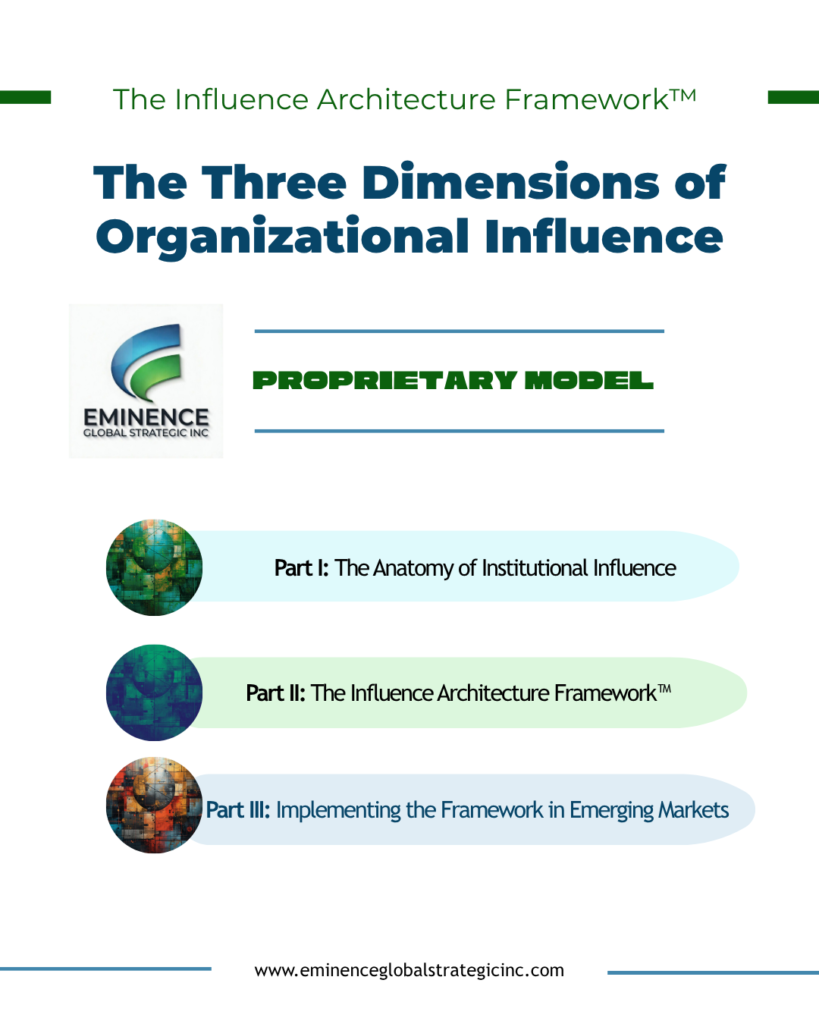
The Three Dimensions of Organizational Influence
Eminence Global Strategic Inc.’s research across hundreds of organizational engagements has identified three distinct dimensions of organizational influence, each requiring different strategic approaches and different organizational capabilities.
Narrative Influence is the capacity to shape how stakeholders understand an institution’s identity, intentions, and significance. It operates primarily through communications but communications of a specific quality: consistent, credible, and strategically coherent across audiences and over time. Narrative influence is the most visible dimension and the one most often confused with the totality of influence strategy. In fact, it is only one dimension and without the other two, it is structurally insufficient.
Relational Influence is the capacity to affect outcomes through the quality and depth of stakeholder relationships. It operates through sustained engagement with regulators, investors, partners, communities, and the informal networks of advisors and intermediaries who shape institutional environments. Relational influence is built slowly and eroded quickly. It requires genuine investment in relationship quality, not merely relationship management.
Structural Influence is the capacity to shape the frameworks regulatory, industry, social within which institutional activity occurs. It operates through participation in policy processes, industry standard-setting, thought leadership, and the broader ecosystem of institutional activity that defines the rules of the game. Structural influence is the least visible and most powerful dimension. Institutions that achieve it operate in environments partially of their own design.
Part II: The Influence Architecture Framework™
Framework Overview
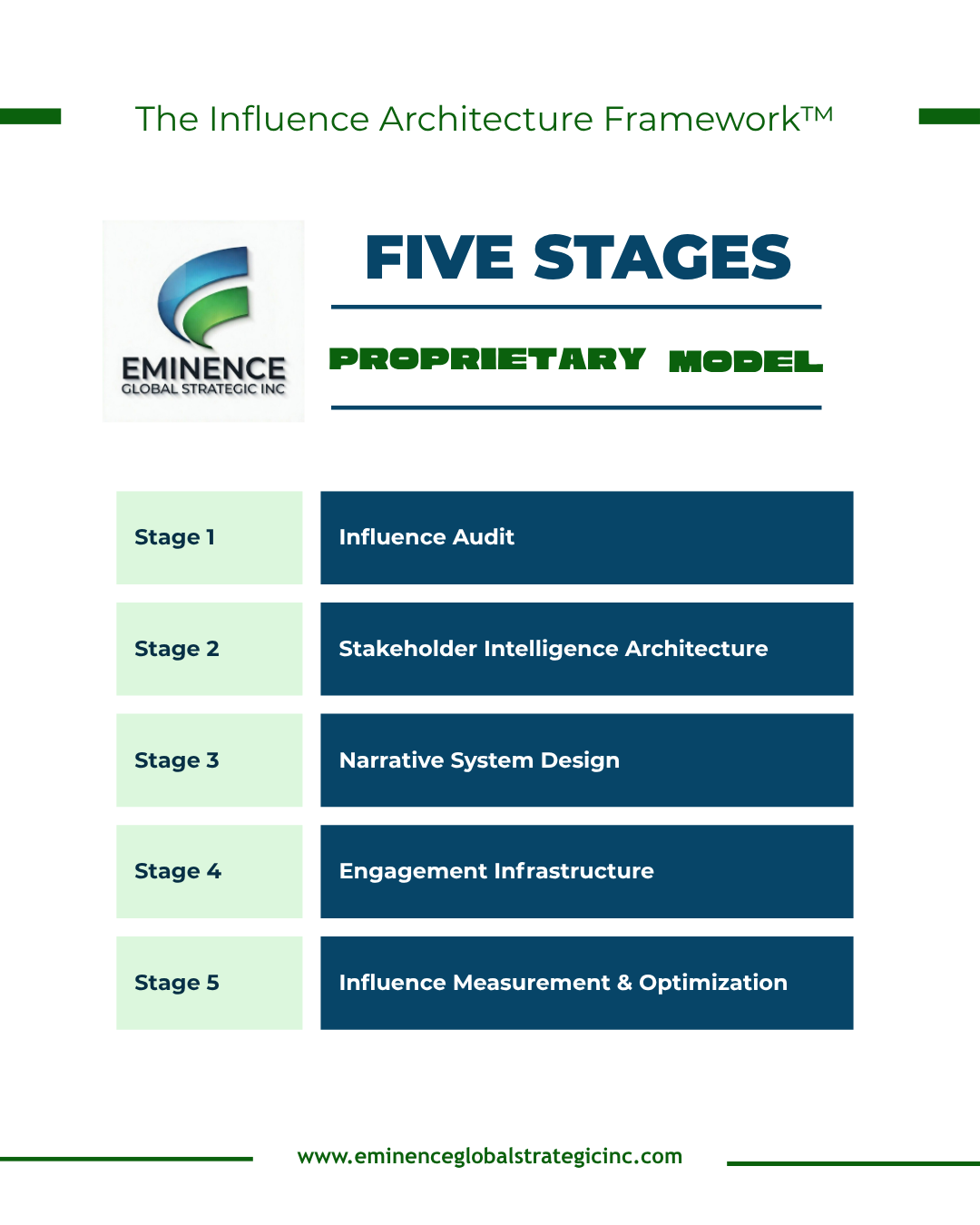
The Eminence Influence Architecture Framework provides a structured methodology for building institutional influence across all three dimensions. The framework comprises five integrated stages, each building on the preceding one and each contributing specific outputs to the overall influence architecture.
◆ THE INFLUENCE ARCHITECTURE FRAMEWORK™ – FIVE STAGES
| Stage 1: Influence Audit – Systematic assessment of current institutional influence across all three dimensions: narrative, relational, and structural. Identifies influence deficits, maps stakeholder perceptions, benchmarks against peer institutions, and establishes baseline metrics for progress measurement. |
| Stage 2: Stakeholder Intelligence Architecture – Development of comprehensive stakeholder maps that identify the individuals, organizations, and networks that most significantly shape institutional outcomes. Prioritizes stakeholders by influence weight, assesses relationship quality, and identifies the informal power structures that official organizational charts do not reveal. |
| Stage 3: Narrative System Design – Construction of the institutional narrative architecture, the integrated system of messages, frameworks, and communications vehicles through which institutional identity, strategy, and values are communicated consistently to all stakeholder audiences. Aligns internal and external narrative, develops executive voice architecture, and creates the message discipline systems that ensure consistency over time. |
| Stage 4: Engagement Infrastructure – Design and implementation of the stakeholder engagement systems. This entails, events, content programs, relationship protocols, and communication cadences through which the institutional narrative is delivered and relational influence is built. Sequences engagements strategically, differentiates approaches by stakeholder tier, and creates the regular interaction cadences that sustain relationship quality. |
| Stage 5: Influence Measurement & Optimization – Establishment of the metrics, monitoring systems, and review processes through which influence performance is tracked and optimized. Includes narrative sentiment monitoring, stakeholder relationship quality assessments, structural influence indicators, and regular strategic reviews that enable continuous improvement of the overall architecture. |
Stage 1 in Depth: The Influence Audit
The Influence Audit is the diagnostic foundation of the entire Influence Architecture Framework. Its purpose is to generate an honest, evidence-based assessment of where an institution currently stands across the three dimensions of influence not where institutional leadership believes it stands, but where its actual stakeholder audiences perceive it to be.
The gap between institutional self-perception and stakeholder perception is, in our advisory experience, the single most common source of strategic misalignment in institutional communications. Institutions that believe they are highly credible with regulators are frequently surprised to discover that regulatory relationships are more transactional and trust-limited than they had assumed. Institutions that believe their investor narrative is compelling discover that sophisticated investors interpret their communications with significant skepticism. Institutions that believe they are seen as thought leaders discover that their target audiences primarily encounter them as service providers.
The Influence Audit corrects this misalignment through structured stakeholder research, confidential interviews with representatives of key stakeholder groups, analysis of media and digital sentiment, assessment of regulatory relationship quality, and benchmarking against peer institutions. The output is a comprehensive Influence Diagnostic Report that provides the evidence base for all subsequent strategic decisions.
Stage 2 in Depth: Stakeholder Intelligence Architecture
The Stakeholder Intelligence Architecture is among the most consequential and most consistently underinvested components of institutional influence strategy. Most institutions have stakeholder maps of some kind lists of key relationships, perhaps organized by category. Very few have genuine stakeholder intelligence architectures: systematic, continuously updated, analytically rich pictures of the full stakeholder ecosystem and the informal networks through which influence actually flows.
The distinction matters because influence frequently travels through informal channels more than formal ones. The regulatory official whose views are most important to a specific approval process may be significantly influenced by an academic advisor whose existence is not captured on any standard stakeholder map. The institutional investor whose capital allocation decision matters most may be disproportionately influenced by a research analyst with whom the institution has no relationship. The political figure whose support is most critical to a market entry may defer to a business council leader who has never been engaged.
Genuine stakeholder intelligence architecture identifies these informal influence pathways and builds them into the engagement strategy. It transforms stakeholder management from the management of official relationships to the management of actual influence flows a fundamentally different and far more powerful discipline.
Stage 3 in Depth: Narrative System Design
The Narrative System is the integrated architecture of messages, frameworks, and communications vehicles through which an institution communicates its identity to the world. It is not a tagline. It is not a communications strategy. It is a comprehensive system that ensures consistency of narrative across every touchpoint through which stakeholder audiences encounter the institution.
The most common failure in institutional narrative management is not content quality but system quality. Individual communications are often well-crafted; the overall effect is often incoherent. Different spokespersons use different frameworks to describe the institution’s strategy. Different functions communicate different priorities. Different external audiences receive different versions of the institutional story. The result is a fragmented institutional narrative that fails to build the cumulative authority that consistent narrative creates.
Narrative System Design addresses this fragmentation by creating the master narrative architecture from which all institutional communications are derived: a core narrative framework that articulates the institution’s identity, strategy, and values with sufficient precision and flexibility to guide all communications while leaving room for contextual adaptation to specific audiences.
Part III: Implementing the Influence Architecture Framework in Emerging Markets
The Emerging Market Adaptation
The Influence Architecture Framework was developed with emerging market operating environments at its core, not as an afterthought. The specific characteristics of high-growth emerging markets, the primacy of personal relationships in regulatory and government engagement, the significance of informal power structures, the complexity of multi-stakeholder environments with competing legitimate interests, and the speed with which political and regulatory conditions can change all shape the framework’s design.
In emerging market contexts, the Stakeholder Intelligence Architecture stage takes on particular importance. The formal regulatory and government stakeholder maps that suffice in more institutionalized environments are frequently inadequate in markets where informal networks carry significant decision-making weight. Identifying and engaging the informal influencers traditional authorities, business associations, diaspora networks, religious leaders, and the personal networks of key officials requires intelligence capabilities and cultural fluency that go far beyond conventional stakeholder management.
The Narrative System Design stage also requires specific adaptation for emerging market audiences. Global narrative frameworks developed for sophisticated international investors or Northern European regulators frequently land badly with local stakeholders whose priorities, reference points, and communication expectations are different. The most effective emerging market institutional narratives combine international-standard sophistication with genuine local resonance demonstrating knowledge of and respect for the specific national context in which the institution operates.
Measuring the Return on Influence Architecture Investment
One of the most common objections to systematic investment in influence architecture is the difficulty of measuring its return. The outcomes of influence regulatory approvals, investment decisions, partnership formations, talent attraction are multi-determined, and isolating the contribution of influence architecture from other causal factors is genuinely challenging.
Yet measurement is possible, and it is essential for maintaining institutional commitment to influence investment over the medium to long term that genuine influence architecture Framework requires. The most effective measurement approaches combine leading indicators metrics of influence inputs and intermediate outcomes that are clearly connected to influence activities with lagging indicators that track ultimate business outcomes over longer timeframes.
Leading indicators include narrative consistency scores across stakeholder audiences, stakeholder relationship quality ratings from structured assessments, media sentiment trends, regulatory engagement quality metrics (speed of approval processes, frequency of constructive informal engagement, nature of official communications), and executive visibility indicators. These metrics provide ongoing feedback on influence performance that enables strategic optimization without waiting for ultimate business outcomes.
Architecture Is Destiny
The institutions that will occupy the most powerful and most durable positions in the global competitive landscape of the next decade will not necessarily be those with the greatest capabilities or the deepest resources. They will be those that have most effectively translated their capabilities and resources into stakeholder authority through deliberate, systematic, and sustained investment in influence architecture.
The Influence Architecture Framework™ provides the strategic methodology for this translation. It is built on the conviction that influence is not a soft complement to institutional strategy but its structural precondition, the architecture through which strategy becomes achievable, resources become deployable, and capability becomes consequential.
Institutions do not fail because they lack capability. They fail because they lack architecture. Influence Architecture™ is the blueprint for institutional authority. – Milkaela M Mwangura, Director, Eminence Global Strategic Inc.
About Eminence Global Strategic Inc.
Eminence Global Strategic Inc. is a premier strategic communications and institutional advisory firm serving corporations, financial institutions, sovereign entities, and development organizations across emerging and global markets. Our practice integrates narrative strategy, executive positioning, crisis architecture, ESG communications, corporate diplomacy, and stakeholder intelligence into comprehensive institutional authority programs.
We are the strategic partner of choice for institutions that understand that authority must be earned, reputation must be engineered, and influence must be sustained.
Inquiries: Projects@eminenceglobalstrategicinc.com | advisory@eminenceglobalstrategicinc.com
