
In the modern economy, trust is not a virtue, it is a variable. It moves markets, shapes regulatory outcomes, influences investor appetite, and determines the long-term sustainability of institutional power. Yet despite its strategic weight, reputation continues to be treated by too many organizations as an afterthought managed reactively in moments of crisis rather than engineered deliberately as institutional capital.
The Eminence Global Team underscores that reputation is among the most consequential and undervalued assets on any institution’s balance sheet. Drawing on frameworks developed across decades of strategic communications advisory in emerging and global markets, we make the case that organizations that fail to architect their reputational capital with the same rigor they apply to financial capital are structurally exposed in ways that may not be visible until the moment they are most damaging.
For institutions operating in Africa, the Gulf, Southeast Asia, and other high-growth emerging markets, the stakes are even higher. In environments where regulatory frameworks are still maturing, where investor scrutiny is intensifying, and where digital connectivity has made every stakeholder a broadcaster, reputational mismanagement is not merely embarrassing. It is existential.
Reputation is no longer a soft asset. It is institutional capital and it must be managed with the same precision as financial capital.
The Architecture of Institutional Trust
From Visibility to Credibility: Understanding the Gap
There is a persistent and dangerous conflation in corporate communications between visibility and credibility. Organizations invest heavily in advertising, public relations, and social media presence, accumulating awareness at scale. Yet awareness without authority is structurally hollow. An institution can be known and not trusted, visible and not believed, present and not influential.
Across our work with institutions spanning diverse sectors, we’ve learned that credibility is a distinct class of asset, one that accumulates through sustained consistency of behavior, narrative, and stakeholder engagement. It is not manufactured in press releases, but earned in the alignment between what an institution claims to stand for and what it demonstrably practices. And it is validated not in moments of ease, but in moments of pressure, when the true depth of an institution’s commitments is revealed.
The distinction matters enormously in capital markets. When investors assess risk, they are not merely evaluating financial metrics they are assessing institutional quality. Management credibility, governance integrity, and narrative consistency are embedded in every valuation judgment, even when they are not explicitly named. Risk premiums are, in part, credibility discounts. The lower the institutional credibility, the higher the cost of capital.
In regulatory environments, the dynamic is similarly structural. Regulators who trust an institution’s leadership and governance frameworks process approvals more efficiently, engage more constructively, and are less likely to apply maximum scrutiny to routine filings. Credibility accelerates the machinery of compliance. Its absence creates friction at every level.
For institutions in emerging markets where regulatory relationships are often more personal, where the line between public and private interest is frequently blurred, and where reputational missteps can trigger disproportionate political responses the credibility gap is a strategic liability with direct operational consequences.
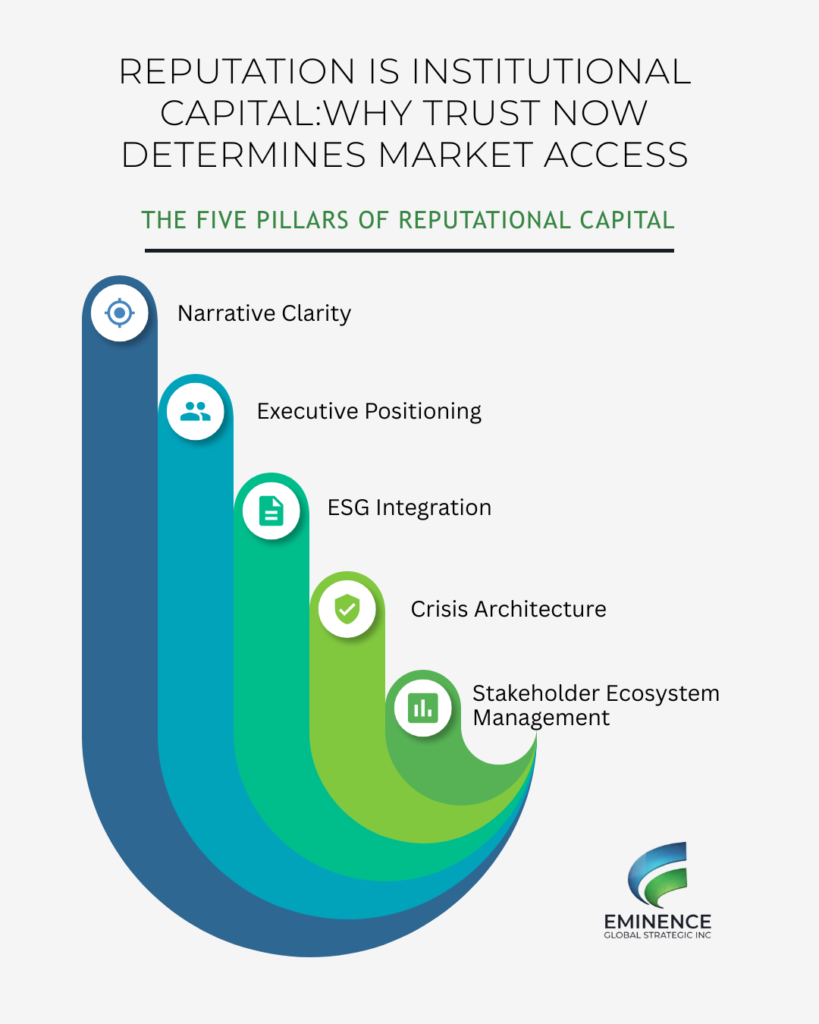
The Five Pillars of Reputational Capital
Eminence Global Strategic Inc. has identified five structural pillars that collectively constitute an institution’s reputational capital architecture. Each pillar is independently significant; together, they form the integrated foundation upon which sustained institutional authority is built.
- Narrative Clarity – The organization has a clearly articulated, internally consistent, and externally coherent story about who it is, what it stands for, and where it is going. This narrative is not a marketing slogan but it is a strategic document, aligned with operational reality and calibrated for every key stakeholder audience. Institutions with strong narrative clarity are better positioned to maintain message discipline in volatile environments, to onboard new stakeholders efficiently, and to frame industry discourse on their own terms.
- Executive Positioning – The individuals who lead an institution are among its most powerful reputational assets or liabilities. Executive authority must be deliberately architected through platform selection, thought leadership cadence, media discipline, and narrative alignment with institutional strategy. When leaders are visible, credible, and consistent, they amplify institutional authority. When they are absent, contradictory, or poorly positioned, they create strategic vulnerability.
- ESG Integration – Environmental, Social, and Governance credentials are no longer compliance checkboxes but they are credibility signals that sophisticated investors and regulators interpret as proxies for institutional quality. Institutions with genuinely embedded ESG frameworks, not performative disclosures but operationally integrated commitments carry lower perceived risk and command greater stakeholder confidence. The credibility gap in ESG is currently vast, and institutions that close it gain meaningful competitive differentiation.
- Crisis Architecture – How an institution performs in moments of pressure is the ultimate test of its reputational foundation. Organizations that have invested in crisis preparedness scenario planning, spokesperson training, stakeholder sequencing protocols, and real-time sentiment monitoring contain volatility. Those that have not amplify it. The absence of crisis infrastructure is itself a reputational risk.
- Stakeholder Ecosystem Management – Reputation is not managed in isolation, it is co-created with stakeholders. Investors, regulators, media, civil society, employees, and communities each hold a partial claim on institutional reputation. Organizations that manage these relationships with strategic intentionality sequencing engagements, calibrating disclosure, and investing in long-term trust maintain greater narrative control than those who treat stakeholder relations as transactional or reactive.
Why Most Institutions Get This Wrong
The systemic failure in institutional reputation management is not a matter of ignorance most senior leaders understand intuitively that trust matters. The failure is architectural. Reputation is managed as a function rather than a discipline, housed in communications departments with limited access to strategic decision-making and constrained by short-term cycles that reward visibility over credibility.
In most organizations, communications teams are typically mobilized in response to events rather than in anticipation of them. Narrative development happens downstream of strategy rather than upstream of it. Stakeholder relationships are maintained transactionally activated when something is needed, neglected when it is not. Crisis preparedness is deferred in favor of operational priorities until the moment when its absence is catastrophic.
This is not a resource problem. It is a governance problem. The institutions that manage reputation most effectively have elevated it to the strategic level treating it as a capital allocation decision, a board-level priority, and a core component of institutional risk management.
Reputation Under Pressure: The Architecture of Resilience
What Crisis Reveals
Crisis is the ultimate diagnostic for reputational capital. In moments of regulatory scrutiny, digital activism, operational failure, or investor questioning, the quality of an institution’s reputational architecture becomes immediately legible. The difference between institutions that emerge from crises stronger and those that emerge diminished or destroyed is not the severity of the triggering event but it is the quality of the preparation that preceded it.
Digital acceleration has fundamentally altered the crisis landscape. What once unfolded over days like a regulatory inquiry, a governance scandal, or an operational failure, now escalates within hours. Social media compresses the feedback loop between event and narrative, between perception and consequence. Misinformation proliferates faster than factual correction. Stakeholder reaction, amplified by digital networks, can reach institutional-threatening scale before traditional communications infrastructure has been mobilized.
The institutions that navigate this environment successfully are not those with the best PR firms on retainer. They are those that have invested in structural preparedness: clear decision protocols, pre-approved messaging frameworks, trained spokespersons, mapped stakeholder landscapes, and real-time monitoring capabilities. These are not luxuries but they are fundamental survival infrastructures.
The Regulatory Dimension
Regulatory risk is among the most underappreciated dimensions of reputational exposure. In emerging and global markets, where regulatory frameworks are often less predictable and where personal relationships between institutions and regulators carry significant weight, reputational missteps can trigger disproportionate official responses.
Institutions with strong regulatory relationships built through consistent transparency, constructive engagement, and demonstrated alignment with national development priorities enjoy a degree of institutional protection that is difficult to quantify but significant in practice. When things go wrong, regulators who trust institutional leadership are more likely to engage privately before acting publicly, more likely to accept remediation plans in lieu of punitive action, and more likely to give institutions the benefit of the doubt in ambiguous interpretive situations.
Conversely, institutions with poor regulatory relationships characterized by opacity, adversarial positioning, or perceived misalignment with public interest face maximum scrutiny in every interaction. Every filing becomes a compliance risk. Every gray area becomes a potential enforcement action. The reputational deficit creates a regulatory multiplier effect that compounds operational challenges over time.
Digital Activism and the Stakeholder Economy
The rise of digital activism has democratized reputational threat. Previously, the primary sources of institutional reputational risk were limited: media, regulators, investors, and competitors. Today, any organized stakeholder group with digital connectivity and narrative coherence can generate reputational pressure that commands boardroom attention.
Our research has established that this is not inherently negative. Institutions that are genuinely aligned with stakeholder values that operate transparently, that honor their commitments, that engage constructively with communities have little to fear from digital accountability. The threat is concentrated among institutions that operate with a gap between their stated values and their actual behavior. In a digitally connected world, that gap is increasingly difficult to maintain.
The strategic implication is clear: authentic reputation built on genuine operational integrity rather than narrative management alone is more durable and more defensible than curated reputation. Institutions that invest in the operational substance of their commitments, not merely in the communications wrapping around them, are better positioned for long-term resilience.
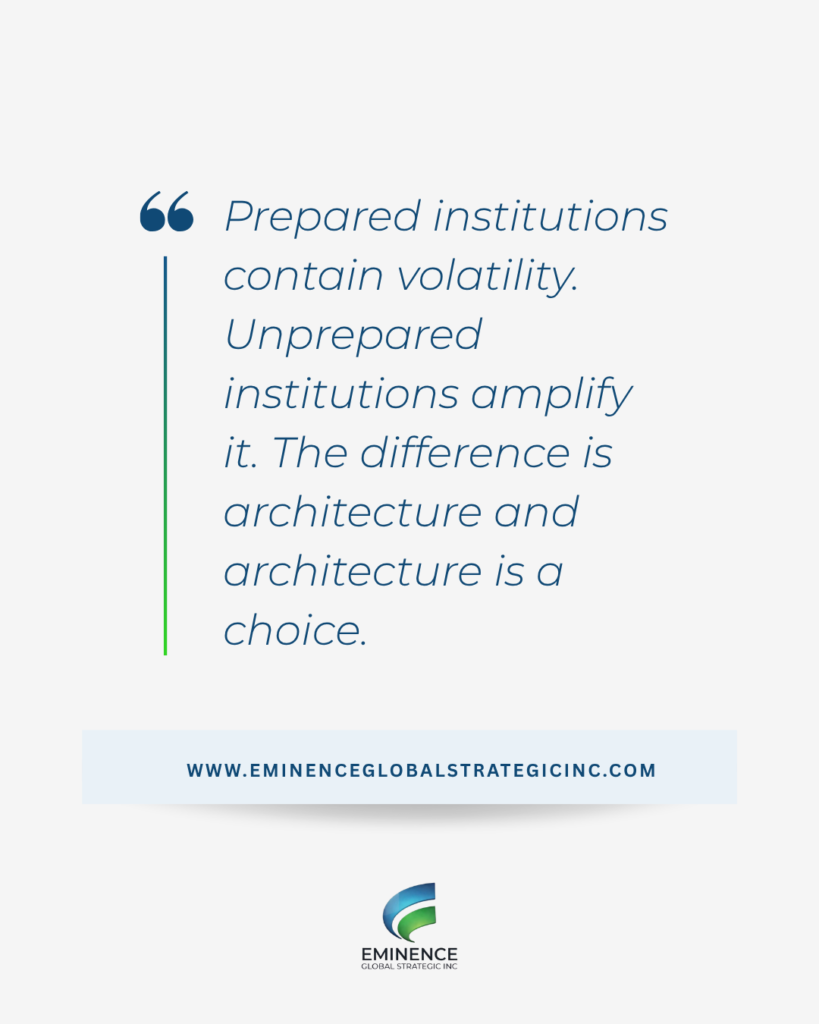
Prepared institutions contain volatility. Unprepared institutions amplify it. The difference is architecture and architecture is a choice.
Reputation as Competitive Advantage in Emerging Markets
The Emerging Market Premium
Institutions operating in emerging markets face a paradox: the markets with the highest growth potential also carry the highest reputational risk. Political instability, regulatory unpredictability, currency volatility, and governance challenges create an environment in which institutional reputation must work harder to compensate for market-level risk factors.
Yet this very dynamic creates opportunity for institutions that invest strategically in reputational capital. In markets where institutional trust is scarce, it commands a premium. Investors pay more for quality. Regulators extend more latitude to credible partners. Communities engage more constructively with institutions they trust. The reputational premium in emerging markets is real, measurable, and sustainable for institutions that commit to building it authentically.
The key differentiators in emerging market reputational strategy are three: demonstrated local commitment, governance credibility, and narrative alignment with national development priorities. Institutions that can credibly demonstrate all three through operational behavior, not merely communications positioning occupy a uniquely powerful market position that is difficult for competitors to replicate.
Governance Credibility as Market Access
In many emerging markets, governance quality is the single most important determinant of market access. Governments, development finance institutions, and sophisticated private investors increasingly apply governance screens to institutional partnerships not merely assessing operational capability, but evaluating the quality of boards, the integrity of decision-making processes, and the consistency between stated values and actual behavior.
Institutions that can demonstrate genuine governance quality through transparent reporting, diverse and capable boards, clear accountability structures, and documented risk management frameworks unlock access to capital and markets that remain closed to institutions that cannot. This is not a compliance exercise but it is a strategic investment in market access.
The reputation-access link is tightening as ESG integration accelerates in global capital markets. The largest institutional investors in the world sovereign wealth funds, pension funds, and development finance institutions are increasingly routing capital through governance quality filters. Institutions in emerging markets that align their governance frameworks with these global standards gain access to significantly deeper pools of capital than those that do not.
The Role of Thought Leadership in Reputational Architecture
Thought leadership is among the most powerful and underutilized tools in institutional reputation management. When executed with strategic discipline through rigorous intellectual content, authentic executive voice, and consistent platform presence thought leadership establishes an institution as a knowledge authority in its domain, creating credibility that advertising cannot buy and crisis cannot easily destroy.
The most effective institutional thought leadership operates at the intersection of genuine expertise and stakeholder relevance. It addresses questions that its target audiences are actually asking, provides frameworks and insights that create genuine value, and positions the institution’s leadership as participants in important conversations rather than promoters of self-interest.
In practice, thought leadership strategy requires investment in content quality, platform selection, and sustained execution. It is not a campaign. It is a discipline. Institutions that treat it as such, maintaining consistent intellectual presence across economic cycles and news environments, build the kind of cumulative authority that becomes genuinely valuable in moments when institutional credibility matters most.
The Institutional Imperative: Building a Reputation Management System
From Reactive to Proactive
The shift from reactive to proactive reputation management is not merely a communications strategy but it is an organizational transformation. It requires changes in governance structure, resource allocation, decision-making protocol, and cultural orientation. It requires, above all, a genuine commitment from senior leadership to treat reputation as the strategic asset it is.
Institutions that have made this shift share several common characteristics. They have established clear ownership of reputational strategy at the most senior level whether through a dedicated C-suite function, a board-level committee, or an integrated governance framework that ensures communications strategy is aligned with business strategy from the outset. They invest in monitoring and intelligence capabilities that provide early warning of emerging reputational risks. They maintain ongoing stakeholder engagement programs that are not dependent on having something to announce.
Critically, they treat reputational investment as a capital allocation decision recognizing that resources deployed in building trust, maintaining stakeholder relationships, and developing crisis preparedness generate returns in the form of reduced risk premiums, smoother regulatory relationships, and faster recovery from inevitable crises.
The Role of External Advisory
Even the most sophisticated internal communications teams benefit from external advisory partnerships that provide market intelligence, strategic objectivity, and specialized expertise unavailable in-house. The most valuable advisory relationships are those that function as genuine strategic partners providing not merely tactical communications execution but integrated counsel on how reputational considerations should inform business strategy.
Eminence Global Strategic Inc. was established to provide this level of integrated advisory to institutions operating in emerging and global markets. Our practice is built on the conviction that reputation management is a strategic discipline not a communications function and that institutions that treat it as such gain sustainable competitive advantage.
Our approach integrates narrative strategy, executive positioning, crisis preparedness, ESG communications, and stakeholder engagement into a coherent institutional architecture designed for maximum resilience and sustained credibility. We work with clients to build the structural foundations of trust that determine market access, regulatory relationships, and long-term institutional authority.
Metrics That Matter
One of the primary obstacles to elevating reputation to strategic status is the difficulty of measurement. Unlike financial capital, reputational capital does not appear on balance sheets. Its value is indirect, emergent, and often realized most clearly in its absence rather than its presence.
Yet measurement is possible, and it is essential for strategic management. The most sophisticated institutional reputation programs track a combination of quantitative indicators media sentiment analysis, stakeholder survey data, regulatory engagement quality scores, investor perception indices and qualitative assessments of narrative consistency, stakeholder relationship depth, and crisis preparedness readiness.
Over time, these metrics enable institutions to identify reputational trends, assess the impact of strategic interventions, benchmark against peer institutions, and make informed resource allocation decisions. They transform reputation from a soft concept into a managed asset with trackable performance characteristics.
Conclusion: Trust as Infrastructure
The institutions that will define the next generation of global commerce particularly in the high-growth emerging markets that will drive the majority of global economic expansion over the coming decades, will be those that understand trust not as a virtue to be aspired to but as infrastructure to be built.
Reputational capital, properly understood and strategically managed, is a compound asset. It grows through consistent investment, generates returns across multiple dimensions of institutional performance, and – crucially – provides protection in moments of volatility that cannot be purchased after the fact.
The organizations that invest in this architecture today that treat communications strategy as institutional strategy, that elevate reputation management to the level of board oversight, that build genuine stakeholder trust rather than manage stakeholder perception will occupy positions of sustainable authority that their competitors will find impossible to replicate.
In a world defined by scrutiny, disruption, and accelerating complexity, trust is not optional. It is the foundation on which everything else is built. And foundations must be engineered with care.
About Eminence Global Strategic Inc.
Eminence Global Strategic Inc. is a premier strategic communications and institutional advisory firm operating across emerging and global markets. We partner with corporations, financial institutions, governments, and development organizations to build the reputational capital, stakeholder authority, and communications infrastructure required for sustainable institutional excellence. For strategic advisory engagements or projects, email projects@eminenceglobalstrategicinc.com | advisory@eminenceglobalstrategicinc.com
