
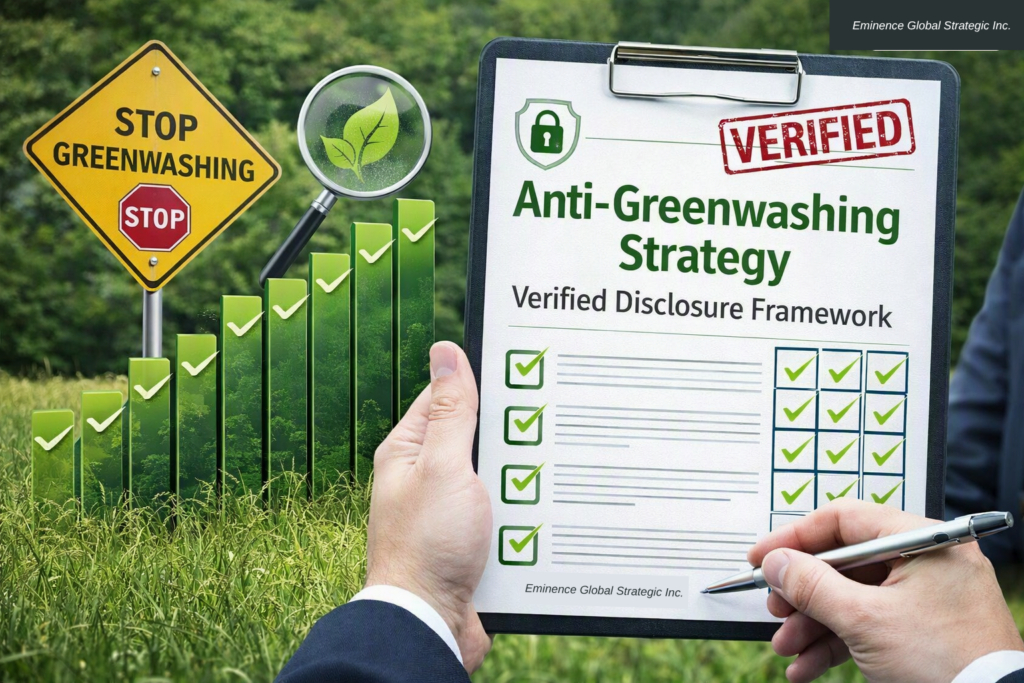
The global landscape for Environmental, Social, and Governance (ESG) communications has reached an unprecedented regulatory and legal inflection point. Unsubstantiated corporate environmental claims, vague commitments to “eco-friendliness,” and poorly documented net-zero roadmaps are no longer treated merely as public relations missteps. Today, they constitute acute financial, legal, and operational liabilities. Regulators, institutional investors, environmental non-governmental organizations (NGOs), and class-action litigants are actively targeting corporations with severe enforcement actions, financial penalties, and criminal liability for misleading sustainability statements.
Global Greenwashing Risks & Exposure
Regulatory Enforcement
Investor Litigation
NGO & Public Audit Exposure
For multinational corporations, asset managers, industrial conglomerates, and consumer goods enterprises, the challenge of sustainability communications lies in navigating the balance between demonstrating genuine environmental leadership and avoiding regulatory or reputational exposure. As mandatory reporting frameworks replace voluntary disclosures, vague marketing language must be systematically eliminated and replaced by scientifically verified, audit-ready data.
To protect enterprise value and maintain global market access, corporate leaders require a comprehensive Anti-Greenwashing Strategy & Verified Disclosure Framework.
By systematically mapping global regulatory mandates, enforcing evidence-first messaging standards, aligning reporting with global disclosure benchmarks (ISSB, GRI, CSRD), managing activist NGO audits constructively, and establishing strict internal legal and technical governance controls, organizations convert ESG compliance into a lasting competitive advantage.
Anti-Greenwashing & Verified Disclosure Architecture
Regulatory Compliance Mapping
Cross-referencing climate disclosures with SEC, EU CSRD, ESMA, and UK CMA legal requirements to preempt regulatory enforcement.
Evidence-Based Messaging
Auditing external sustainability claims against verifiable carbon accounting, supply chain metrics, and primary data sources.
Internal Governance Controls
Establishing rigorous sign-off workflows, verification protocols, and oversight mechanisms prior to public ESG disclosure release.
Eminence Global Strategic Verified Disclosure Framework
I. Regulatory Scrutiny Mapping: Auditing Claims Against Strict Guidelines from the SEC, EU Taxonomy, and Regional Authorities
The regulatory environment governing corporate environmental claims has undergone a structural transition, shifting from voluntary guidelines and self-reported sustainability pledges to legally binding, enforceable statutory regimes. Regulators across North America, Europe, and the Asia-Pacific region now actively scrutinize corporate reporting, treating misleading environmental claims not as benign marketing overstatements, but as material misrepresentations, consumer fraud, and securities violations. Multinationals operating across jurisdictions face an interlocking web of compliance frameworks that mandate standardized metrics, third-party assurance, and strict scientific substantiation for every public ESG statement.
Global Regulatory Enforcement Matrix
European Union (EU)
U.S. SEC
UK CMA & FCA
Australia ASIC & ACCC
1. Mapping the European Union’s Enforcement Architecture: CSRD, EU Taxonomy, and Green Claims Directive
The European Union serves as the global regulatory benchmark for anti-greenwashing enforcement, establishing a comprehensive reporting regime that impacts both EU-headquartered firms and non-EU multinationals with significant European operations. Under this regulatory umbrella, vague corporate marketing language is replaced by audited, standardized metrics backed by explicit statutory liabilities
EU Compliance Overlay Flow
CSRD Mandatory Reporting
Establishing double materiality metrics and audited sustainability disclosures under EU reporting standards.
EU Taxonomy Alignment
Mapping capital allocation and revenue streams against strict European environmental activity definitions.
Green Claims Pre-Verified
Third-party substantiation of environmental messaging to ensure complete Green Claims Directive compliance.
The EU compliance framework operates across three distinct yet interdependent regulatory pillars:
- 1. Corporate Sustainability Reporting Directive (CSRD): Replacing the legacy Non-Financial Reporting Directive (NFRD), the CSRD vastly expands the scope of mandatory reporting to encompass approximately 50,000 enterprise entities, including non-EU parent companies generating over €150 million in EU net turnover. The directive enforces compliance with the European Sustainability Reporting Standards (ESRS) and introduces the mandatory concept of double materiality. Under double materiality, enterprises cannot selectively disclose only their financial exposures; they must report both how climate and sustainability risks impact the organization’s financial value (financial materiality) and how the organization’s operations impact ecosystems and communities (impact materiality). Furthermore, disclosures must undergo mandatory limited assurance by an independent auditor, progressing toward reasonable assurance standards in subsequent reporting cycles.
- 2. EU Taxonomy Regulation: The Taxonomy acts as a unified, scientifically grounded classification system designed to define what truly constitutes an environmentally sustainable economic activity. To market an asset, project, or revenue stream as “green,” enterprises must prove through quantitative criteria that the activity contributes substantially to at least one of the EU’s six environmental objectives: climate change mitigation, climate change adaptation, sustainable use of water, transition to a circular economy, pollution prevention, or protection of biodiversity. Simultaneously, the activity must satisfy the strict Do No Significant Harm (DNSH) principle across the remaining five objectives while maintaining full compliance with Minimum Social Safeguards regarding international labor standards and human rights.
- 3. Green Claims Directive & Substantive Verification: Designed to eliminate consumer-facing greenwashing, the Green Claims Directive targets explicit, voluntary environmental claims made in commercial communications. The directive effectively bans generic, unquantified claims such as “climate neutral,” “eco-friendly,” “biodegradable,” or “nature-positive” unless backed by verified life-cycle assessments (LCAs) and certified by an accredited independent verifier prior to public release. Crucially, the directive explicitly restricts carbon offset-based neutrality claims, prohibiting companies from advertising products as “carbon neutral” if that status relies primarily on unverified, off-site carbon credits rather than direct operational decarbonization.
2. United States Enforcement Framework: SEC Rules, FTC Green Guides, and State AG Scrutiny
In the United States, enforcement centers on securities fraud, material misrepresentation to investors, and deceptive commercial practices. Companies face parallel oversight from federal financial regulators, trade commissions, and aggressive state attorneys general.
- 1. SEC Climate-Related Disclosures & Names Rule: The U.S. Securities and Exchange Commission enforces strict standards regarding climate risk transparency for public companies. Under these regulations, public registrants must disclose material climate risks, severe weather impact costs, and climate-related transition plans within their standardized financial filings (10-K). Concurrently, the SEC’s amended Names Rule mandates that funds using ESG, green, or sustainable nomenclature must invest at least 80% of their asset value in accordance with those explicit strategy names, subjecting investment advisors to severe regulatory penalties for misleading fund positioning.
- 2. FTC Green Guides Modernization: The Federal Trade Commission regulates environmental marketing under Section 5 of the FTC Act, prohibiting unfair or deceptive trade practices. Updated FTC enforcement targets deceptive claims surrounding recyclability, carbon offsets, zero-waste claims, and net-zero claims, placing the burden of proof squarely on the enterprise to maintain rigorous, scientific data substantiating all public marketing claims.
- 3. State-Level Litigation & Consumer Protection: Individual state attorneys general and private class-action litigants increasingly leverage state consumer protection acts to prosecute corporations for deceptive green claims. High-profile litigation targets misleading plastics recyclability claims, exaggerated net-zero targets, and offset quality, creating substantial legal and reputational exposure across domestic markets.
3. UK & Asia-Pacific Oversight: CMA Green Claims Code, ASIC, and Global Convergence
Anti-greenwashing enforcement extends globally, with major regulatory bodies across the UK, Australia, and Asia-Pacific harmonizing their oversight frameworks around the International Sustainability Standards Board (ISSB) standards (IFRS S1 and S2).
- 1. UK Competition and Markets Authority (CMA) & FCA: The UK’s CMA enforces its Green Claims Code, which outlines six fundamental principles for environmental marketing, including the requirement that all claims be truthful, accurate, unambiguous, and supported by full life-cycle evidence. Simultaneously, the Financial Conduct Authority (FCA) enforces its broad Anti-Greenwashing Rule, empowering regulators to penalize financial institutions and funds whose sustainability claims are not fair, clear, and non-misleading.
- 2. Australian Securities and Investments Commission (ASIC) & ACCC: In Australia, ASIC and the Australian Competition and Consumer Commission (ACCC) maintain an aggressive enforcement posture against corporate greenwashing. ASIC targets public companies and superannuation funds for issuing misleading statements regarding carbon neutrality, ESG investment screens, and clean energy targets, imposing substantial civil penalties and mandatory corrective disclosures on non-compliant entities.
- 3. ISSB Alignment across Asia-Pacific Markets: Financial hubs across Singapore, Japan, Hong Kong, and South Korea are actively codifying ISSB climate disclosure standards into mandatory domestic reporting laws. This rapid convergence forces international corporations operating in the APAC region to standardize their climate data, emissions accounting, and transition strategies to maintain access to institutional capital markets.
II. Evidence-First Sustainability Messaging: Grounding All Public Statements in Verified, Third-Party Scientific Data
The core vulnerability in modern corporate communications is the widening gap between aspirational marketing narrative and verified operational reality. For decades, corporate sustainability messaging relied on broad, feel-good adjectival claims that resonated in consumer advertising but lacked quantitative grounding. Under current regulatory enforcement, this legacy approach represents acute financial and legal liability. Transitioning to an Evidence-First Sustainability Messaging Framework requires replacing vague marketing language with precise, scientifically validated metrics that withstand independent forensic audit.
Anti-Greenwashing Terminology Matrix
“100% Eco-Friendly Packaging”
“Carbon Neutral Enterprise”
“Sustainable Supply Chain”
1. Eliminating Ambiguous Language & Standardizing Science-Based Claims
Generic environmental terms invite immediate regulatory scrutiny and class-action litigation. An evidence-first framework establishes a mandatory corporate lexicon across all investor relations, public relations, and marketing touchpoints. Under this model, no public statement regarding environmental performance may be released without a direct, verifiable link to scientific data and third-party audit documentation.
Evidence Substantiation Pipeline
Raw Operational Data
Aggregating primary meter telemetry, direct supply chain disclosures, and verifiable carbon accounting logs.
Independent Third-Party Audit
Subjecting underlying methodology and data inputs to accredited external assurance and verification standards.
Audit-Ready Claim
Publishing fully substantiated, legally compliant disclosures protected against regulatory and litigation risks.
To achieve absolute compliance, corporate claims must be channeled through a three-stage evidence substantiation pipeline that converts operational measurements into legally defensible public narratives.
- Standardizing Science-Based Targets (SBTi Alignment): Public carbon reduction commitments must be explicitly anchored in validated Science Based Targets aligned with the 1.5°C decarbonization trajectory established by the Paris Agreement. Framing corporate reduction targets under Science Based Targets initiative (SBTi) guidelines provides institutional credibility, demonstrates operational rigor, and insulates the organization against shareholder litigation charging management with speculative or hollow goal-setting.
- Life Cycle Assessment (LCA) Product Substantiation: Product-level environmental claims must be supported by peer-reviewed Life Cycle Assessments conducted in strict accordance with ISO 14040/14044 standards. A compliant LCA measures total environmental impacts across the entire value chain from raw material extraction, processing, and manufacturing through distribution, consumer use, and end-of-life disposal. Basing product narratives on comprehensive LCAs prevents accusations of cherry-picking isolated environmental benefits while ignoring upstream or downstream ecological costs.
- Data Lineage and Assurance Integration: Operational data supporting sustainability claims must maintain an auditable line of custody. Enterprise Resource Planning (ERP) systems and specialized ESG management software must track emissions and resource metrics at the source, ensuring that data presented in annual sustainability reports matches the audited numbers submitted to financial regulators.
2. The Strategic Management of Carbon Neutrality & Offsetting Claims
Regulators globally are actively penalizing organizations that proclaim “carbon neutrality” when that status is achieved primarily through cheap, unverified carbon avoidance offsets rather than absolute, on-site operational emissions reductions. To preserve brand equity and maintain regulatory compliance, corporate management must fundamentally restructure how carbon credits are utilized, categorized, and publicly disclosed.
Carbon Crediting & Claims Matrix
Avoidance Offsets
Carbon Removal Credits
Public Claims Reporting
- 1. Strict Decoupling of Operational Abatement vs. Offsetting: Corporate reporting architecture must explicitly separate absolute emissions reductions achieved through operational decarbonization from carbon credits purchased to balance residual emissions. Conflating operational reductions with credit purchases conceals underlying performance trends and creates immediate regulatory exposure under EU, UK, and U.S. disclosure rules.
- 2. Verifiable Credit Sourcing & Durability Verification: When carbon credits are deployed to address hard-to-abate residual emissions, they must be sourced exclusively from accredited, independent registries (e.g., Gold Standard, Verra) with documented proof of additionality, permanence, and social safeguards. Furthermore, enterprise risk management must transition away from short-term avoidance credits toward durable, engineered carbon dioxide removal (CDR) technologies-such as Direct Air Capture (DAC), biochar, and enhanced weathering—that guarantee long-term carbon sequestration.
- 3. Transparent Credit Disclosure Frameworks: For every credit retired, corporate communications must publicly disclose project identification numbers, registry links, underlying quantification methodologies, and third-party verification reports. Disclosing these granular details demonstrates radical transparency and eliminates the ambiguity that invites greenwashing allegations.
III. Managing Environmental Disclosures: Aligning Annual Sustainability Reports with ISSB, GRI, and TCFD Standards
While outward-facing marketing and product claims represent a visible greenwashing threat, the primary vector for regulatory enforcement and institutional shareholder action lies in annual sustainability disclosures, investor prospectuses, and statutory filings. Regulators and capital markets no longer accept fragmented, narrative-heavy ESG reporting. To eliminate greenwashing risk at the corporate reporting level, enterprises must align their disclosure architecture with recognized global reporting frameworks that mandate standardized, quantitative, and auditable metrics.
Reporting Standards & Governance Framework Matrix
ISSB (IFRS S1 & S2)
GRI (Global Reporting Initiative)
TCFD Framework
1. Harmonizing Frameworks into a Unified Reporting Architecture
Navigating the global reporting landscape requires moving away from cherry-picked reporting frameworks toward an integrated disclosure model. The International Sustainability Standards Board (ISSB) has consolidated legacy frameworks—including the Task Force on Climate-related Financial Disclosures (TCFD) and the Sustainability Accounting Standards Board (SASB)—into a comprehensive global baseline for investor-focused reporting. Concurrently, the Global Reporting Initiative (GRI) remains the gold standard for multi-stakeholder impact transparency.
A compliant, audit-ready reporting architecture connects these standards into a cohesive disclosure pipeline:
- – Implementing ISSB (IFRS S1 & S2) for Financial Materiality: IFRS S1 sets general requirements for disclosing sustainability-related financial information, while IFRS S2 focuses explicitly on climate-related disclosures. Under IFRS S2, enterprises must report gross Scope 1, Scope 2, and Scope 3 greenhouse gas emissions calculated in accordance with the GHG Protocol Corporate Standard. Crucially, companies must disclose the internal carbon prices used in capital allocation decisions, quantitative target milestones, and climate transition plans, leaving no room for unsubstantiated forward-looking statements.
- – Anchoring Governance in TCFD Pillars: Although TCFD’s monitoring functions have been subsumed into the ISSB, its core four-pillar structure—Governance, Strategy, Risk Management, and Metrics & Targets—remains the baseline for board oversight. Annual reports must explicitly describe how the Board of Directors and Audit Committee supervise climate risks, how physical and transition risks impact short- and long-term financial planning, and how climate risk identification is integrated into the broader Enterprise Risk Management (ERM) framework.
- – Integrating GRI for Double Materiality Coverage: To satisfy European CSRD mandates and broader stakeholder expectations, organizations must pair ISSB financial reporting with GRI standards. While ISSB addresses how climate impacts enterprise financial value, GRI provides the technical metrics required to disclose how the enterprise impacts biodiversity, water resources, waste streams, and local communities. Integrating both frameworks fulfills double materiality requirements and eliminates accusations of selective, investor-only reporting.
2. Executing Climate Scenario Analysis & Eliminating Selective Reporting
A common form of corporate greenwashing occurs when organizations publish ambitious 2030 or 2050 Net-Zero commitments without disclosing the underlying financial assumptions, technology dependencies, or scenario modeling required to achieve them. To withstand scrutiny from regulators and forensic auditors, forward-looking climate assertions must be backed by quantitative scenario analysis.
Disclosure Focus & Risk Compliance Matrix
Climate Scenario Analysis
Scope 3 Accounting Boundary
Baseline Modifications
- – Quantitative Climate Scenario Analysis: Reports must evaluate business model resilience against multiple temperature scenarios, including a $1.5^\circ\text{C}$ decarbonization pathway and higher-warming physical risk scenarios ($2^\circ\text{C}$ and $3^\circ\text{C}+$ addressable warming). Disclosures should quantify financial impacts under each scenario—such as asset impairment from physical weather events, carbon pricing liabilities, and capital expenditure costs required for transition technologies.
- – Rigorous Scope 3 Accounting and Boundary Integrity: Attempting to hide value chain carbon intensity by excluding key Scope 3 categories is a primary trigger for regulatory enforcement. Enterprises must map all 15 categories of Scope 3 emissions defined under the GHG Protocol. Where secondary estimation data is used instead of primary supplier data, the report must disclose the underlying assumptions, estimation methodologies, and data quality scores.
- – Transparent Re-Baselining and Structural Adjustment Policies: When organizations engage in mergers, acquisitions, or divestitures, operational carbon footprints shift dramatically. To prevent allegations of manipulating baseline years to mask flat or rising emissions, annual reports must outline a transparent Base Year Recalculation Policy. Any structural change exceeding a predefined materiality threshold (e.g., 5% of gross emissions) requires a formal restatement of historical baselines with full explanatory disclosures.
IV. Responding to Environmental NGO Audits: Engaging Constructively with Activist Groups Raising Legitimate Queries
Environmental Non-Governmental Organizations (NGOs), investigative journalism collectives, and shareholder activist groups serve as primary enforcement catalysts in the global ESG ecosystem. Utilizing satellite imagery, supply chain forensic tracking, and quantitative emissions auditing, these entities frequently uncover discrepancies long before regulatory authorities initiate formal investigations.
When an organization receives a technical inquiry, audit request, or public challenge from an activist group, responding defensively, issuing dismissive public relations statements, or threatening legal action almost always escalates the conflict. Such missteps transform localized technical queries into high-visibility viral campaigns, shareholder resolutions, and immediate regulatory investigations. A constructive, evidence-based engagement strategy protects enterprise reputation while demonstrating operational integrity and regulatory compliance.
Stakeholder & Activist Engagement Response Matrix
Initial Inquiry
Technical Evaluation
Post-Audit Action
1. Triage & Technical Evaluation of NGO Inquiries
Not all activist queries are hostile attacks; many stem from legitimate technical discrepancies identified in public filings, sustainability reports, or supply chain disclosures. Establishing an institutionalized triage protocol ensures inquiries are evaluated systematically by technical, operational, and legal experts rather than treated as standard public relations challenges.
NGO Inquiry Response Pipeline
Triage & Verification Analysis
Logging incoming stakeholder inquiries, assessing scope, and initiating an immediate technical acknowledgment.
Technical Data Audit Review
Cross-functional verification of underlying emissions data, boundary assumptions, and calculation methodologies.
Fact-Based Collaborative Dialogue
Engaging external stakeholders with transparent, audited metrics and clear corrective milestone roadmaps.
An effective technical response pipeline requires structured, interdisciplinary coordination across three distinct operational stages:
- 1. Immediate Cross-Functional Triage & Pause on Related Marketing: Route incoming NGO inquiries directly to a specialized response team comprising Sustainability, Investor Relations, Legal Counsel, and Corporate Communications leads. Simultaneously, place a temporary hold on related outward-facing marketing campaigns while the internal audit takes place. Acknowledge receipt of the query within 24 to 48 hours, providing a clear timeline for a technical response without offering premature denials.
- 2. Evaluating Methodology & Accounting Boundary Discrepancies: Activist audits often uncover discrepancies stemming from differing carbon accounting methodologies, emissions factors, or organizational boundary assumptions (e.g., operational control vs. equity share approach under the GHG Protocol). The enterprise response team must map the NGO’s methodology against internal audit models, isolate where variance occurs, and share data boundary assumptions transparently during technical dialogues.
- 3. Direct Technical Engagement over Public Media Debates: Engage activist technical teams through private, technical working sessions rather than issuing combative press releases. Conducting fact-based, engineer-to-engineer discussions depoliticizes the dialogue, clarifies misunderstandings around operational constraints, and establishes a reputation for scientific rigor.
2. Managing Public Challenges & Executing Corrective Disclosure Protocols
If an internal audit confirms an error, material omission, or overstated claim in corporate disclosures, taking proactive, transparent corrective action is critical to maintaining credibility with capital markets, regulators, and civil society. Attempting to quietly alter digital disclosures or conceal calculation errors invites severe accusations of deceptive intent and greenwashing.
Incident Remediation & Restatement Framework
Overstated Carbon Reduction Calculation
Unverifiable Supplier Sustainability Claim
Unachieved Forward-Looking Target
- 1. Transparent Restatement Protocols: When an environmental metric or public claim is found to be inaccurate, the enterprise should issue a formal disclosure restatement detailing the nature of the error, the root cause of the miscalculation, and the verified, corrected metric. Proactive restatement demonstrates robust corporate governance, establishes good faith, and significantly reduces the likelihood of regulatory fines or enforcement actions.
- 2. Supplier Non-Compliance Enforcement: When NGO audits expose environmental non-compliance or human rights violations within Tier-1 or Tier-2 supplier networks, the organization must act decisively. This includes issuing formal corrective action plans to vendors, requiring third-party verification, or terminating non-compliant supplier contracts when remediation benchmarks are missed.
- 3. Converting Criticisms into Collaborative Advisory Frameworks: Where appropriate, leading enterprises invite technical NGOs and academic experts to participate in independent sustainability advisory panels or joint supply chain auditing initiatives. Engaging credible critics constructively transforms potential public conflicts into collaborative progress, strengthening long-term ESG governance.
Here is Section V expanded with executive-level depth, seamless narrative transitions, and rigorous institutional governance substance, fully eliminating all ASCII boxes while preserving structured scannability.
V. Building Internal Governance Controls: Ensuring Marketing Teams Consult Legal and Technical Staff Before Releasing Claims
The most reliable defense against greenwashing enforcement is a structurally enforced internal governance framework. In modern enterprise environments, greenwashing rarely originates from intentional corporate deceit. Far more frequently, it stems from institutional communication breakdowns between marketing teams seeking emotionally compelling campaigns and technical sustainability engineers who understand the boundaries, uncertainties, and regulatory limitations of the underlying data.
Without rigid internal gatekeeping, well-intentioned creative teams inevitably translate complex operational metrics into simplified, broad environmental assertions that invite immediate regulatory penalties and class-action litigation. Establishing clear multi-departmental oversight ensures that no outward-facing environmental claim enters the public domain without rigorous empirical validation and legal sign-off.
Internal Cross-Functional Governance & Gatekeeping Matrix
Marketing & Public Relations
Sustainability & ESG Engineering
Corporate Legal & Compliance
1. Implementing the Three-Tier Claim Clearance Protocol
To systematically prevent unvetted or exaggerated environmental statements from reaching investors, consumers, or regulators, organizations must embed a mandatory, sequential sign-off protocol into their standard content publishing workflow. This mechanism governs all external communication channels including press releases, social media campaigns, annual reports, investor decks, product packaging, and executive keynote speeches.
Three-Tier Claim Clearance Flow
Tier 1: Marketing Proposal
Drafting value propositions and communications collateral; submitting initial narrative concepts for gatekeeping review.
Tier 2: Technical Audit
Validating operational metrics, LCA accounting parameters, data freshness, and underlying evidence substantiation.
Tier 3: Legal & Compliance
Evaluating regulatory risk profiles across target jurisdictions and executing final sign-off before external publication.
The clearance architecture operates through three sequential checkpoints, moving progressively from creative drafting to empirical auditing and final legal sign-off:
- Tier 1 – Marketing Proposal & Substantiation Questionnaire: Communications teams draft proposed campaign copy and complete a mandatory Green Claim Substantiation Questionnaire. This intake submission requires the author to pinpoint every explicit and implicit environmental claim, state the intended distribution channels, specify geographic markets, and attach the preliminary evidence supporting the assertion.
- Tier 2 – Sustainability & Engineering Data Audit: Specialized ESG engineers and technical staff review the proposal against primary operational data, peer-reviewed Life Cycle Assessments (LCAs), Scope 1-3 accounting records, and third-party audit reports. If supporting evidence is incomplete, methodologically flawed, or based on outdated baselines, technical personnel must either reject the claim outright or narrow its scope to align strictly with audited facts.
- Tier 3 – Legal & Compliance Regulatory Clearance: Corporate legal counsel evaluates the technically verified claim against governing legal standards across target jurisdictions (such as the EU Green Claims Directive, SEC Climate Disclosure Regulations, and FTC Green Guides). Legal counsel assesses enforcement exposure, verifies that required contextual disclaimers are present, and archived the finalized package in an immutable enterprise compliance repository.
2. Establishing an Internal Claim Repository & Enterprise Training Framework
Achieving long-term compliance across decentralized business units, global subsidiaries, and regional communications teams requires centralized tools and continuous operational alignment. Relying on ad-hoc email sign-offs or informal reviews leaves structural gaps that lead to non-compliant regional messaging.
Governance Controls & Risk Mitigation Matrix
Pre-Approved Digital Claim Bank
Mandatory Enterprise Risk Training
Audit-Ready Documentation Archiving
- 1. Digital Claim Bank with Automated Expiration Timers: Enterprises should maintain a centralized, access-controlled repository of approved environmental statements. Each entry must specify exact allowable copy, approved contexts, required disclaimers, and direct links to underlying evidentiary files. Crucially, every claim carries a mandatory expiration date (typically 6 to 12 months). Because operational emissions profiles and supply chain dynamics evolve continuously, expiration timers force periodic technical re-verification before statements can remain in active circulation.
- 2. Enterprise-Wide Greenwashing Risk Training: Conduct tailored, mandatory compliance training for marketing, sales, public relations, investor relations, and executive leadership teams. Training modules must cover global regulatory trends, the legal liabilities associated with unsubstantiated claims, and the mechanics of the Three-Tier Clearance Protocol, ensuring that employees across every department recognize their role in safeguarding corporate integrity.
- 3. Audit-Ready Compliance Logging: Every claim cleared through the three-tier framework must be permanently archived alongside its intake questionnaire, technical review logs, legal approvals, and underlying data sources. Maintaining a searchable audit trail ensures that if a regulatory authority or external auditor challenges a public statement years later, the enterprise can immediately produce the exact scientific and legal justification behind the disclosure.
VI. Strategic Case Studies: Excellence in Anti-Greenwashing Execution & Governance
Examining real-world enterprise responses highlights how proactive disclosure governance, evidence-backed messaging, and constructive stakeholder engagement protect enterprise value and maintain market trust. As regulatory enforcement accelerates globally, leading organizations demonstrate that anti-greenwashing compliance is not merely a legal defense mechanism, but a strategic differentiator that lowers capital costs, secures premium retail positioning, and builds long-term brand equity.
Strategic Compliance Case Studies
Multinational FMCG Corporation
Global Asset Management Firm
1. Consumer Goods Transformation: Moving from Vague Packaging Claims to Verifiable Lifecycle Audits
A global Fast-Moving Consumer Goods (FMCG) manufacturer operating across Europe and North America faced mounting regulatory scrutiny over generic packaging claims, such as “100% eco-friendly” and “ocean-safe,” printed across millions of consumer packaging units. Regulatory authorities flagged these statements as potentially deceptive under regional consumer protection laws, while activist NGOs published supply chain audits questioning the actual end-of-life processing of the materials.
Claim Substantiation & Transformation Matrix
“100% Eco-Friendly & Ocean-Safe Packaging”
| Legacy High-Risk Marketing Claim | Audited Evidence-First Replacement Strategy |
| “100% Eco-Friendly & Ocean-Safe Packaging” | “Packaging contains 70% post-consumer recycled plastic (PCR); fully recyclable in regions with municipal polyethylene collection infrastructure.” |
The enterprise addressed this operational and regulatory challenge through a three-stage transformation framework:
- 1. Complete Removal of Generic Claims & Packaging Audit: The corporation initiated an immediate global recall of non-compliant packaging messaging, purging ambiguous adjectives like “green,” “eco-conscious,” and “planet-friendly” from all SKUs. Marketing teams were required to align all new packaging artwork with verified material composition data.
- 2. ISO 14040/14044 Life Cycle Assessment Integration: The enterprise engaged accredited third-party environmental auditors to conduct peer-reviewed Life Cycle Assessments (LCAs) across its entire product portfolio. These assessments established empirical baselines for material sourcing, carbon intensity, water usage, and real-world recyclability rates across varying regional waste management systems.
- 3. Deployment of Open-Access Disclosure Portals: To satisfy regulatory inquiries and consumer demands for transparency, the organization launched an interactive digital disclosure dashboard. Consumers and regulatory bodies can scan on-pack QR codes to view audited material sourcing certifications, percentage breaks of post-consumer recycled content, and specific regional infrastructure prerequisites for recycling. This proactive approach satisfied EU regulator inquiries, insulated the firm from class-action litigation, and secured preferred shelf-space with major international retailers requiring verified ESG compliance data from suppliers.
2. Asset Management Integration: Aligning Fund Disclosures with SEC and ISSB Benchmarks
An international asset manager overseeing ESG-themed investment funds faced severe regulatory risk following heightened scrutiny under the U.S. SEC’s updated Fund Names Rule, the UK FCA’s Anti-Greenwashing Rule, and Australia’s ASIC enforcement guidelines. Regulators challenged the firm’s investment screening process, questioning whether portfolio holdings genuinely reflected the “sustainable,” “clean energy,” and “climate leader” labels featured in fund prospectuses and investor marketing decks.
ESG Compliance Risk & Strategic Outcome Matrix
Regulatory scrutiny over ESG fund screening criteria
Potential mislabeling exposure & regulatory penalties
Institutional investor redemptions & reputational risk
- – Portfolio Realignment with IFRS S2 & EU Taxonomy: The firm initiated a comprehensive audit of all portfolio holdings across its ESG-branded product line. Portfolio management teams re-evaluated every asset against International Sustainability Standards Board (ISSB) climate metrics (IFRS S1/S2) and EU Taxonomy alignment thresholds. Holdings that failed to meet quantitative carbon intensity and climate risk criteria were removed, and funds whose core strategies could not meet strict statutory green thresholds were re-labeled to reflect their actual strategy.
- – Institutionalization of the Three-Tier Marketing Sign-Off: The asset manager established a formal clearance protocol requiring investment management, compliance officers, and specialized ESG analysts to jointly approve all fund prospectuses, investor presentations, and public marketing copy. This gatekeeping mechanism ensures that forward-looking sustainability assertions match the quantitative reality of underlying asset allocations.
- – Commercial Acceleration through Verified Stewardship: Beyond regulatory compliance, the firm published detailed proxy voting records, active ownership engagement logs, and portfolio-level Scope 1–3 carbon attribution reports. By demonstrating radical transparency and eliminating non-compliant fund positioning, the firm successfully resolved open regulatory inquiries without fines, restored institutional investor confidence, and attracted significant net inflows of ESG impact capital from institutional pension funds.
VII. Operational Execution Roadmap: Institutionalizing an Anti-Greenwashing & Verified Disclosure Framework
Transitioning an enterprise from vulnerable, aspirational sustainability narratives to an evidence-first, audit-ready compliance posture requires deliberate cross-functional execution. Organizations cannot eliminate systemic greenwashing risks through policy statements alone; they must systematically embed technical data controls, legal review gates, and standardized science-based lexicons directly into daily operating workflows.
To execute this transition effectively, enterprise leadership should implement a structured 12-month operational roadmap divided into four distinct, sequential phases.
Strategic Roadmap & Operational Execution Matrix
Phase I: Regulatory & Disclosure Audit
Phase II: Governance & Lexicon Rollout
Phase III: Framework Alignment & Data Systems
Phase IV: External Assurance & Launch
Operational Implementation & Governance Roadmap
1. Phase I & Phase II: Inventory, Exposure Mapping, and Governance Rollout
The first half of the operational roadmap focuses on identifying existing liabilities, halting non-compliant public statements, and institutionalizing strict internal clearance workflows across all marketing and corporate communication touchpoints.
Phase I: Audit & Exposure Mapping
Months 1–3- Global Claim Inventory: Conduct a forensic audit of every active public-facing environmental assertion across digital assets, packaging, advertising, investor presentations, and regulatory filings (e.g., 10-K, CSRD statements).
- Jurisdictional Liability Mapping: Evaluate inventoried claims against applicable legal guidelines across operating regions, explicitly assessing exposure under the U.S. SEC Rules, EU Green Claims Directive, UK CMA Code, and Australian Consumer Law.
- Risk Categorization & Immediate Remediation: Classify identified claims into low-, medium-, and high-risk tiers. Immediately purge high-risk, unverified claims (e.g., “100% eco-friendly” or unsubstantiated “carbon neutral” statements) from active distribution.
Phase II: Governance & Lexicon Rollout
Months 4–6- Three-Tier Clearance Protocol Activation: Formally integrate the mandatory Three-Tier Claim Clearance Protocol (Marketing Intake → Sustainability Audit → Legal Approval) into enterprise content management systems.
- Evidence-First Lexicon Deployment: Publish an internal corporate messaging handbook that defines banned terminology, mandates science-based replacements, and outlines required substantiation metrics (e.g., requiring ISO 14040/14044 LCAs for product footprint statements).
- Enterprise Compliance Training: Execute mandatory training workshops for global marketing, sales, public relations, and investor relations teams to enforce adherence to the new gatekeeping standards.
2. Phase III & Phase IV: Data Infrastructure, Third-Party Assurance, and Report Launch
The second half of the implementation cycle transforms raw operational metrics into verified, audit-ready disclosures, culminating in independent third-party assurance and transparent public release.
Double Materiality Assessment
Data System Upgrade
Third-Party Limited Assurance
Verified Public Release
Phase III: Framework Alignment & Integration
Months 7–9- Double Materiality Execution: Execute a rigorous double materiality assessment aligned with CSRD (ESRS) and GRI standards, mapping both financial climate risks to the business and operational impacts on society and ecosystems.
- ESG Data Pipeline Integration: Upgrade data collection systems to replace manual spreadsheets with automated Enterprise Resource Planning (ERP) integrations, establishing auditable lines of custody for Scope 1, 2, and 3 emissions metrics.
- Supplier Data Verification: Formalize data-collection protocols for Tier-1 and Tier-2 suppliers, requiring verified documentation for all scope 3 claims and supply chain sustainability assertions.
Phase IV: Assurance & Report Launch
Months 10–12- Independent Third-Party Assurance: Engage an accredited, independent auditing firm to perform limited assurance (progressing toward reasonable assurance) on all carbon, water, waste, and social metrics contained within the draft report.
- Digital Claim Bank Archiving: Upload all finalized disclosures, supporting LCAs, and assurance certificates into the immutable enterprise compliance archive for future regulatory review.
- Proactive Report Launch & Stakeholder Engagement: Publish the verified sustainability report, supported by an open-access disclosure portal and a structured engagement plan targeting institutional investors, regulatory authorities, and NGO technical auditors.
Conclusion
The era of aspirational, unverified corporate sustainability communications has come to an end. Regulators, institutional investors, and activist auditors are holding organizations accountable to strict, science-backed standards. Companies that continue to rely on generic environmental claims face severe legal, financial, and reputational consequences. Conversely, organizations that build robust internal governance, ground claims in scientific evidence, and align disclosures with global reporting standards secure lasting market leadership and stakeholder trust.
At Eminence Global Strategic Inc., we operate at the intersection of regulatory compliance, public affairs, technical ESG strategy, and crisis reputation management. We empower multinational enterprises, institutional asset managers, and industrial leaders to eliminate greenwashing exposure, build audit-ready disclosure frameworks, and communicate environmental achievements with absolute credibility.
By institutionalizing evidence-first messaging, executing double materiality assessments, implementing strict claim clearance controls, and managing stakeholder inquiries constructively, Eminence Global Strategic Inc. equips global leaders to navigate regulatory scrutiny, protect enterprise value, and lead with verified sustainability leadership.
